

Cross Wall Houses, Drought and Subsidence in Pinner
posted 19th October 2026
What a large 1960s development is telling us about this dry summer, and what homeowners should do now.
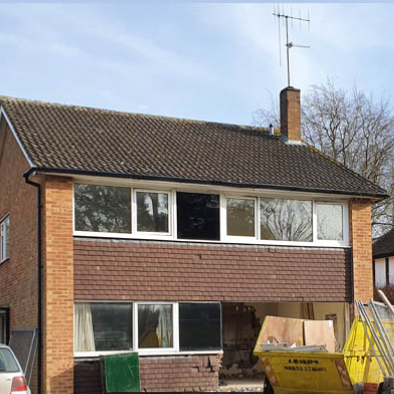
We have recently been instructed to survey a large development of houses built in the mid 1960s using cross wall construction. After one of the driest summers on record, a lot of these homes are showing signs of settlement and slight subsidence, and some also have damp problems. Our brief was to survey the houses, assess the roofs and the internal structure, and advise on the causes.
What is cross wall construction?
In cross wall construction the loadbearing walls run front to back between the houses and carry the floors and roof. The front and rear walls are often lightly loaded. It was quick and economical to build, which made it popular in the 1960s.
In many of these houses the masonry internal walls were built directly off the ground floor slab, a common detail of the period. That works well while the ground and slab stay stable. When the ground moves, the slab can move with it, and walls sitting on it can crack or pull away from the floors, ceilings and walls around them. This is the distress we have been seeing during the current drought.
Why Pinner is vulnerable
Pinner sits on London Clay, one of the most shrinkable soils in the country. Clay shrinks as it dries and swells as it takes water back. Trees draw large amounts of water out of the ground, and in a long dry spell they can dry the clay around foundations to a considerable depth. Leaking or defective drains add to the problem by softening and washing out the ground, which weakens the support under a building.
Shrinkable clay, trees and old drains together are a recipe for movement, and a summer like this one makes it worse. If this weather pattern persists, we expect to see more of these problems across the area.
Settlement is downward movement as a new building beds into the ground. It usually happens early in a building's life and then stabilises.
Subsidence is downward movement of the ground under a building, often caused by clay shrinkage, tree roots or leaking drains.
Heaveis the opposite: upward swelling as clay takes water back, for example after a tree is removed or after a wet winter following a dry summer.
Signs to look for
Diagonal cracks running from the corners of doors and windows, inside or outside
Cracks that are wider at one end, or that open and close with the seasons
Doors and windows that begin to stick
Gaps opening between walls and ceilings, floors or skirting boards
Cracks in internal partition walls, especially at ground floor level
Rippling wallpaper, or new cracks where an extension meets the main house
It is important to assess these early. Movement does not always stop when the rain returns, and clay that has dried out can swell again over the following winter.
Damp is not only a wet weather problem
Our brief also covered damp. Even in a dry summer we see damp caused by defective roof coverings, blocked or leaking gutters and downpipes, failed or bridged damp proof courses, and condensation. Cracks caused by movement can also let rain in. Damp and movement often need to be looked at together, which is why we assess the roof and the internal structure as well as the foundations.
Insurance: report cracking early
Cracking caused by settlement, subsidence or heave is normally covered by buildings insurance, and most policies require you to report it to your insurer promptly. Do not fill the cracks or redecorate first. If the movement continues over a number of years, hidden or repaired cracks can cause difficulties with a claim later.
Policies are also being taken out and switched more often than they used to be. A new policy may not cover movement that has already happened, so historic movement can be excluded. Where you can, stay with the same insurer, even if the premium is a little higher.
Check the wording of your own policy and speak to your insurer or broker. This is general guidance, not insurance or legal advice.
What you should do
Photograph any cracks, with a ruler or coin for scale, and note the date.
Report them to your insurer early.
Do not fill cracks or redecorate until you have taken advice.
Do not remove or heavily prune trees near the house without advice, as this can cause heave.
Keep gutters, gullies and drains clear, and have any suspect drains checked, for example with a CCTV drain survey.
Instruct a chartered building surveyor to establish the cause, whether the movement is ongoing and what repair, if any, is needed. Crack monitoring over a period of months is often the best way to tell.
Worried about cracking or damp?
Tayross Associates Ltd is a firm of Chartered Building Surveyors in Pinner. We can inspect your property, identify the cause and advise on the right next step.
Tayross Associates Ltd
Monument House, 215 Marsh Road, Pinner, Middlesex HA5 5NE