

Solving a Persistent Damp Problem in a Church Hall in Northwood
posted 1st December 2025
A much-used church in Northwood recently contacted Tayross Chartered Building Surveyors about a serious damp problem affecting its main ground floor function room. The hall is an important space for the congregation and wider community, but the floor and lower sections of the walls were suffering from severe dampness and visible deterioration.
A particular concern for the hall managers was that the carpet itself was becoming damp, with distinct patches of moisture appearing through the surface. In addition, cracks were appearing in the floor, presenting as raised ridges more pronounced on one side than the other, which not only looked unsightly but also created a potential trip hazard.
At first glance it looked like a typical rising damp problem – but the construction of the floor, and the pattern of dampness and cracking, did not quite add up. Our survey quickly became a lesson in how water can find the most unexpected paths into a building.
First impressions – more than just “rising damp”
The function room sits over what appears to be a reinforced concrete suspended slab, at least in part. Around the perimeter of the room, the plaster finishes showed:
• Extensive damp staining
• Salt contamination and blistering paint
• Localised deterioration to skirtings and lower wall areas
These defects aligned with the visible damp patches in the carpet, particularly around the outer edges of the room. The carpet felt noticeably cooler and softer underfoot in these areas, consistent with prolonged moisture within the underlying screed.
Externally, there was evidence that some of the damp proof courses (DPCs) around the building had been bridged or compromised over time. However, even taking this into account, the level and extent of dampness at floor level, combined with the pattern of cracking and ridging in the floor, did not quite fit what we would normally expect from straightforward rising damp alone.
In short, the room looked and behaved wetter than the visible DPC defects would justify.
Looking below – inspecting the cellar
Beneath part of the function room is a small cellar space containing a sump and water pump. This system is used to control water when the local water table rises and groundwater builds up in the centre of the site. The pump then discharges excess water to keep the area usable.
Crucially:
• The cellar floor level is not very far below the suspect floor above, but
• The dampness visible in the function room was not directly above the cellar footprint, and
• There were no obvious signs of leakage or failure within the cellar itself affecting the slab above.
From this, we could not confidently attribute the severe dampness and floor distress in the function room to the cellar or sump system alone. The picture still did not fully make sense.
The key clue – a hidden linear drainage channel
The breakthrough came when inspecting a small side window serving the lower level. Looking out through the grilles, we noticed a linear drainage channel running tight against the external wall, set within a sloping footpath that falls down towards the function room area.
On closer internal and external inspection, we established that:
• The linear drainage channel had been partly removed and was defective in sections.
• Historically, this channel had been connected to a surface water manhole to carry away rainwater.
• That connection at the manhole had since been blocked off, meaning the drainage channel no longer discharged effectively.
In effect, a system originally intended to take water away from the building had become a feature that held water against the wall on a sloping path, right beside absorbent brickwork and directly adjacent to the function room.
How the water was actually getting in
By this stage, our working hypothesis was that the external linear drain and footpath were channelling water towards the building and into the construction of the floor, rather than away from it.
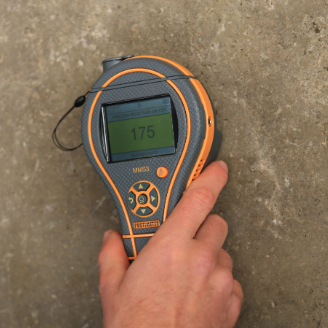
Inside the function room we carried out moisture profiling using a Protimeter and careful mapping of readings across the floor and lower walls. We noted that:
• Moisture readings in the floor screed were significantly elevated, particularly
• Adjacent to the wall where the linear drainage channel sits outside, and
• Dampness in the internal plaster and in the carpet above was worst at these same locations.
The floor screed beneath the carpet was effectively acting like a sponge:
1. Water was being driven against the external wall from the faulty drainage set-up.
2. That water was then tracking into the floor screed rather than dissipating away.
3. The saturated screed allowed moisture to wick up into the internal wall finishes and through to the underside of the carpeting.
Over time, this movement of moisture also contributed to differential movement within the screed, explaining the cracking and raised ridges observed. In areas of persistent saturation, slight heave or localised lifting of the screed can exaggerate cracks on one side, creating the uneven ridged appearance noted during inspection.
Whilst there may have been some contribution from older or compromised DPCs, it was clear that the primary mechanism for the severe dampness and floor distress was the misdirected surface water at the side path and linear drain.
Recommended remedial works – stopping the water at source
Tayross were then asked to advise on a practical specification to tackle the problem. Our recommendations focused on both external water management and internal protection.
1. External drainage and detailing
• Remove or reconstruct the existing linear drainage channel, which currently runs tight against the brickwork.
• Provide a new system (or re-form the existing one) so that it does not discharge water toward the building or hold it against the wall.
• Ensure all new or reinstated channels fall correctly to a functioning surface water outlet, avoiding ponding along the side of the hall.
• Introduce appropriate separation or detailing between the new drainage channel and the absorbent brickwork, to avoid direct water contact where possible.
In summary, the external works must restore the original intention: take water away, not keep it at the wall.
2. Internal floor and wall protection
Given the degree of dampness, the “sponge-like” behaviour of the existing screed and the development of cracking and ridging, we advised that the internal floor build-up needed to be stripped back and tanked:
• Remove the existing screed across the function room to expose the structural slab and allow a proper assessment of its condition.
• Install a tanked screed system (for example, using a proprietary waterproof screed such as a Sika-type system or equivalent, to be fully designed and specified at implementation stage).
• Continue the waterproofing up the internal walls to approximately 1 metre around the perimeter, using a compatible render or tanking render system.
• Carefully detail junctions between floor and wall to provide a continuous waterproof “tray”, reducing the risk of moisture tracking back into finishes.
• Reinstate appropriate floor finishes above, ensuring that any new floor coverings are compatible with the waterproofing system and allow for adequate drying and ventilation.
This approach provides both:
• A robust barrier against any residual ground or lateral moisture, and
• A sound, stable base for new finishes, allowing the function room to be brought back into full use, with a dry carpet and an even walking surface.
Lessons from the investigation
This project is a good illustration of why dampness in buildings is not always what it first appears to be. Key lessons include:
• Do not assume that visible damp at low level is purely “rising damp” from failed DPCs.
• Understand the construction – in this case, a reinforced concrete suspended slab and partial cellar changed the way moisture moved through the structure.
• Follow the water – the real culprit was a defective external drainage channel on a sloping path, directing water into the floor screed rather than away from the building.
• Moisture mapping and careful observation are invaluable – targeted Protimeter readings, external inspection and attention to floor behaviour (cracks, ridges and damp carpeting) confirmed the point of entry and the likely spread of moisture through the screed.
By identifying the true cause, rather than simply treating the symptoms, Tayross Chartered Building Surveyors were able to propose a targeted, long-term solution rather than piecemeal patch repairs.
For churches and community buildings, where halls and function rooms are vital spaces, getting to the root of damp problems is essential. If you manage a similar building and are experiencing persistent dampness, visible patches in floor coverings or unexplained cracking and ridging in floors, a detailed survey of the sort carried out here by Carl Boyle and Joe Morahan of Tayross Chartered Building Surveyors can save significant cost and disruption in the long term by ensuring the right defect is tackled in the right way.