
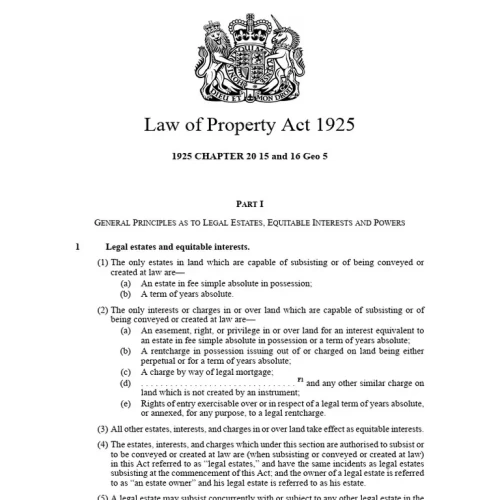
The Law of Property Act 1925 (LPA 1925)
posted 5th January 2026
The Law of Property Act 1925 (LPA 1925) doesn’t amend the Party Wall etc. Act 1996. What it does do—100 years on—is supply a lot of the background “plumbing” of land ownership and notices that Party Wall procedures sit on top of. (That’s exactly why it’s still being discussed as a live, practical statute in centenary events/articles.)
From a party wall surveyor perspective, the LPA 1925 affects practice in a few key, very practical ways:
1) Who counts as an “Owner” you must serve
Party wall validity often lives or dies on serving the right legal “owners”.
• The LPA 1925 is the statute that famously rationalised legal estates so that (in modern terms) the main legal estates are essentially freehold and leasehold.
• The Party Wall Act then builds its own definition of “owner” on top of that, and it can capture multiple people at one property (freeholder, long leaseholder(s), and sometimes a person entitled to rents/profits, etc.).
Implication for surveyors: when you’re identifying “all adjoining owners” (and sometimes multiple “building owners”), you’re implicitly relying on the LPA-style framework of legal estates/interests. Miss a relevant owner and you increase the risk of a notice/award being attacked as invalid.
2) Co-ownership and “equitable” interests: who you actually serve
A lot of land is held by joint owners / trustees, with other people having beneficial (equitable) interests.
Because the LPA 1925 is foundational to the split between legal title and equitable interests, it strongly influences the practical question: “whose name goes on the notice / who must appoint surveyors?”
Implication for surveyors: you generally serve the legal owners shown on the title (often two trustees), not every beneficiary behind the scenes—while still being alert that there may be more than one “owner” for Party Wall purposes under the Act’s definition.
3) Service of notices: Party Wall has its own rules, but LPA 1925 still matters in the background
The Party Wall Act has a dedicated service provision (s.15), including delivery, post to last-known UK residence/business, and (where served “as owner” and the name can’t be ascertained) fixing to a conspicuous part of the premises.
Separately, LPA 1925 s.196 is the general property-law “service of notices” provision, widely used because leases/contracts often incorporate it and it contains deemed service concepts.
Implication for surveyors:
• For Party Wall notices/awards, you follow s.15 PWA 1996 first and foremost.
• But LPA 1925 s.196 still crops up around party wall jobs when you’re also dealing with landlord-and-tenant notices, contractual notice clauses, and “what counts as last-known address / deemed service” arguments that can overlap factually with party wall disputes.
4) Party Wall rights don’t magic away private property constraints the LPA ecosystem helps govern
Even when works are “authorised” under the Party Wall Act, projects can still be constrained by:
• leases (landlord consent requirements),
• restrictive covenants / easements, and
• other proprietary rights whose modern framework traces back to the LPA 1925 reforms and the wider 1925 property legislation “package”.
Implication for surveyors: your award may regulate the party wall process, but it doesn’t automatically solve every underlying property-right issue. It’s one reason surveyors often flag “you may still need landlord consent / covenant advice” alongside PWA compliance.
What this means in day-to-day Party Wall work
If you boil it down to surveyor “implications”, the LPA 1925’s continuing influence shows up as:
• Title/interest checking is not optional (freehold + relevant leaseholds + rent recipients).
• Serving correctly (and proving service) remains a high-risk area—use the Party Wall Act’s s.15 methods, while being aware that LPA-style notice concepts often feature in related property disputes.
• Expect multiple “owners” and build your notice/appointment strategy accordingly.