
When a Building Passes Compliance but Fails Its Occupants
posted 18th May 2026
We recently completed an EWS1 external wall investigation on a large apartment block in Cardiff, standing just under 18 metres in height. From the kerbside it looked like a perfectly conventional masonry building - the kind of construction you might walk past a hundred times without a second thought. What we uncovered behind the outer leaf told a very different story.
The Scope of the Investigation
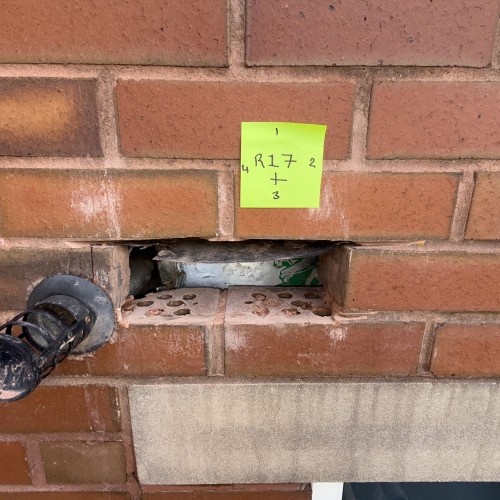
Our brief required intrusive opening up across the building envelope to verify the construction build-up, the materials in use, and the presence (or absence) of fire-stopping within the cavity. We carried out brick removals at approximately 18 separate locations, chosen to give a representative spread across elevations, floor levels, and interfaces such as window reveals, party walls, and floor zones.
EWS1 work is, by its nature, about looking past what is visible. The outer face of a wall reveals very little about what sits behind it, and that is precisely why this form of inspection exists.
What We Found
In short - and to our considerable surprise - we found that no meaningful fire-prevention construction had been carried out within the cavity at any of the opened locations. The issues we recorded included:
• An absence of cavity barriers at the locations where they would reasonably be expected, including around openings and at compartment lines.
• Multiple unsealed entry points back into the building through the inner leaf, providing routes for fire and smoke to bypass intended compartmentation.
• PIR insulation installed within the cavity with no apparent strategy for managing fire spread around or through it.
• Poor general workmanship - missing or displaced components, debris in the cavity, and a standard of installation falling well short of what the Building Regulations require.
Taken together, these findings present an unacceptable level of risk to the occupants of the building. Compartmentation only works if it is continuous. Once it is breached - whether by design, omission, or workmanship - the protection it is supposed to deliver is compromised.
The Question of Compliance
What makes this case especially troubling is that the building was signed off as compliant at the time of construction. It passed Building Control. On paper, everything was in order. On site, it plainly was not.
This is not the first time we have seen a gap of this size between the paperwork and the physical reality of a building, and it will not be the last. The truth is that conventional Building Control inspection regimes have always relied to some degree on samples, photographs, and the good faith of those carrying out the work. Cavity construction is, by definition, hidden once the outer leaf is built. Unless someone is on site at exactly the right moment, defects of the type we found are extremely easy to miss - and once they are buried behind brickwork, they are out of sight entirely.
There must have been a great many blind spots in the original inspection process for issues of this scale to have gone unrecorded.
Why This Matters Beyond One Building
The lessons from Grenfell prompted a long overdue shift in how the industry thinks about external walls, but the focus in public discussion has largely been on cladding systems on taller buildings. Buildings of medium height, with traditional-looking masonry envelopes, have attracted far less attention. Our experience suggests they should attract more.
A brick outer leaf can conceal a cavity that is just as poorly detailed, just as inconsistently fire-stopped, and just as risky as anything seen on a high-rise. The visual reassurance of traditional materials is not the same as evidence of safe construction.
What Owners and Managers Should Take From This
For freeholders, managing agents, and resident-led management companies, the practical takeaways are straightforward:
• Original Building Control sign-off should not be treated as a guarantee of present-day compliance. It is a record of a process, not a warranty of physical fact.
• Where an EWS1 assessment is required, the only reliable form of investigation involves genuine intrusive opening up at a representative number of locations. A visual survey alone will rarely tell you what you need to know.
• If defects of the type described above are found, remediation needs to be planned methodically, properly costed, and communicated openly to leaseholders and occupants.
None of this is comfortable reading, and our intention is not to alarm. It is to be honest about what we see on the ground, because residents and owners deserve nothing less.
Closing Thoughts
A building that passes compliance is not necessarily a building that has been built safely. The Cardiff case is a reminder that the only way to be confident in what lies behind a wall is to look behind it. Our role as building surveyors is to do exactly that - carefully, thoroughly, and without preconceptions about what we expect to find.
If you are responsible for a building of similar age, height, or construction and you have not yet had an intrusive EWS1 assessment carried out, we would encourage you to consider one. The cost of investigation is small compared to the cost of not knowing.